
Florence City Directory Shelf
Florence has a notably long local shelf, but it is not one seamless title. The Florence-Lauderdale Public Library holdings list begins with a regional business volume and moves through several publishers before a dense modern run. Many books cover Florence with Sheffield, Tuscumbia, or Muscle Shoals. Read the title page and place heading before assigning an entry to Florence. The table separates printed directories, phone books, and digitized sources so that a search can start in the right medium.
| Directory set | Florence years | Repository | How to use it |
|---|---|---|---|
| Young's and Polk volumes | 1900; 1913-14; 1920-21; 1926 | FLPL Local History | In person; holdings list online |
| Baldwin, Times, Merchants', and Nelson editions | 1935; 1941; 1945; 1950; 1952; 1954; 1957 | FLPL Local History | In person |
| Polk annual volumes | 1959-60; 1962; 1963-2010 | FLPL Local History | In person |
| Bell South telephone books | 1929-30; 1948; 1951-2010 | FLPL Local History | In person |
| Black business-directory pages | 1913 and 1920 | Shoals Black History | Free online images |
| Florence white pages | 1936-45 and 1946-50 | Library of Congress | Free digitized volumes |
The sequence has gaps before the 1960s, and a missing publication year should not be treated as a missing resident. A telephone book can bridge some breaks, while a census, obituary, or yearbook can explain others. The printed Florence run ends in 2010 in the verified FLPL list.
Florence Directory Publishers Change
The publisher line is part of the evidence. Young's 1900 volume covered leading cities in Tennessee and north Alabama. R. L. Polk produced the Tri-Cities editions of 1913-14, the 1920-21 book, and the 1926 book. Baldwin's, the Times Master Edition, the Merchants' Master Edition, and Nelson titles followed. Polk returned for the later run. A surname found under a Sheffield or Tuscumbia heading is not a Florence address merely because all three towns share one bound volume.
This compact timeline helps place an undated photocopy. It also shows why the front matter matters as much as the name column.
- 1900: Young's regional business and professional directory includes Florence.
- 1913-1926: Polk Tri-Cities and successor editions establish the early named run.
- 1935-1957: Baldwin, Times, Merchants', and Nelson titles alternate.
- 1959-2010: Polk titles return, with near-annual Florence coverage from 1963.
Note: A publisher change can alter abbreviations, place coverage, and section order even when two books sit side by side.
Digitized Florence Directory Pages
Shoals Black History presents authentic 1913 Florence pages from R. L. Polk, and its companion collection has 1920 pages. These images are especially useful because they preserve the original type, categories, addresses, and editorial marks. The books used an asterisk to mark African American businesses. That symbol reflects segregation-era compilation practice. It should be read in context, not copied as if it were a neutral modern label.
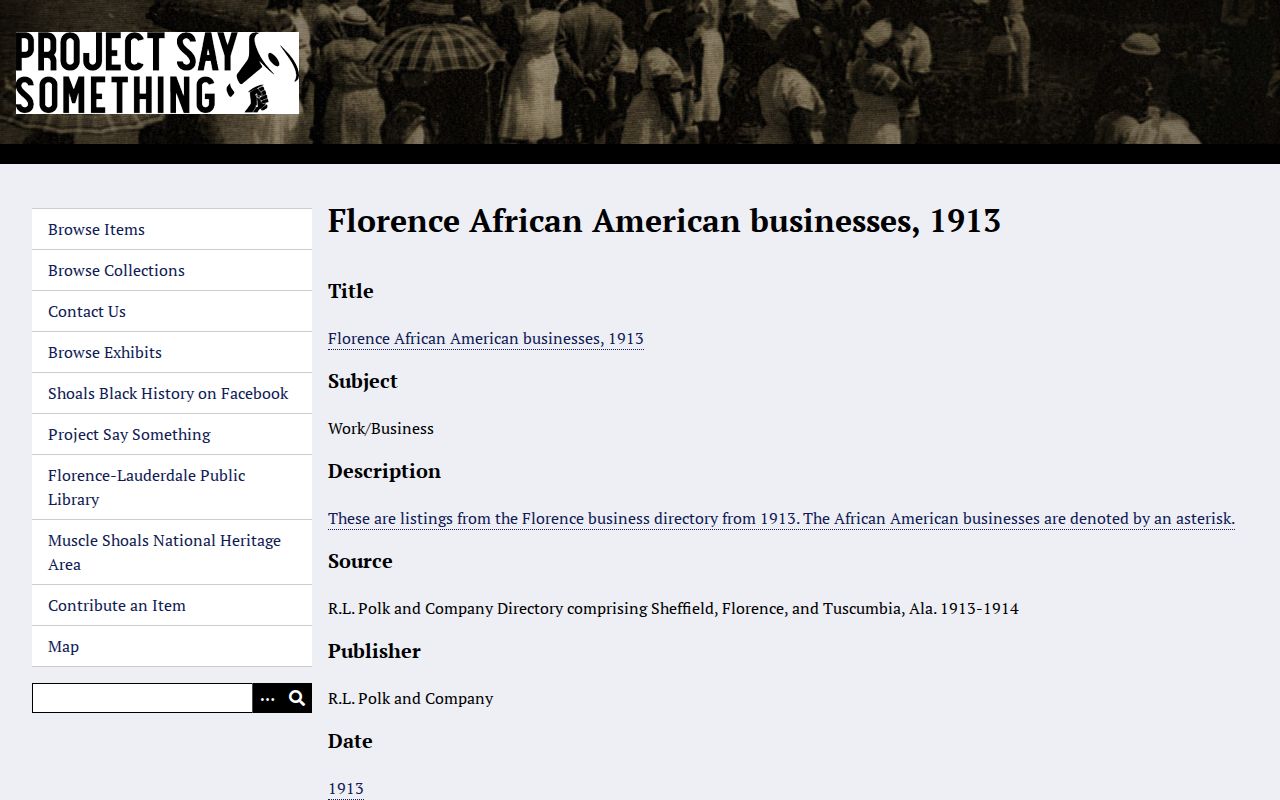
The captured collection page provides a direct path to the historic image and its catalog context. Surviving entries may name a business, church, proprietor, manager, or pastor, then give a numbered street address or a relative spot such as one side of a street between intersections.
The FLPL digital archive adds photographs, documents, and oral histories that can test a directory clue. A photo caption or oral-history name is not a substitute for an entry, but it can confirm a firm, building, or family link.
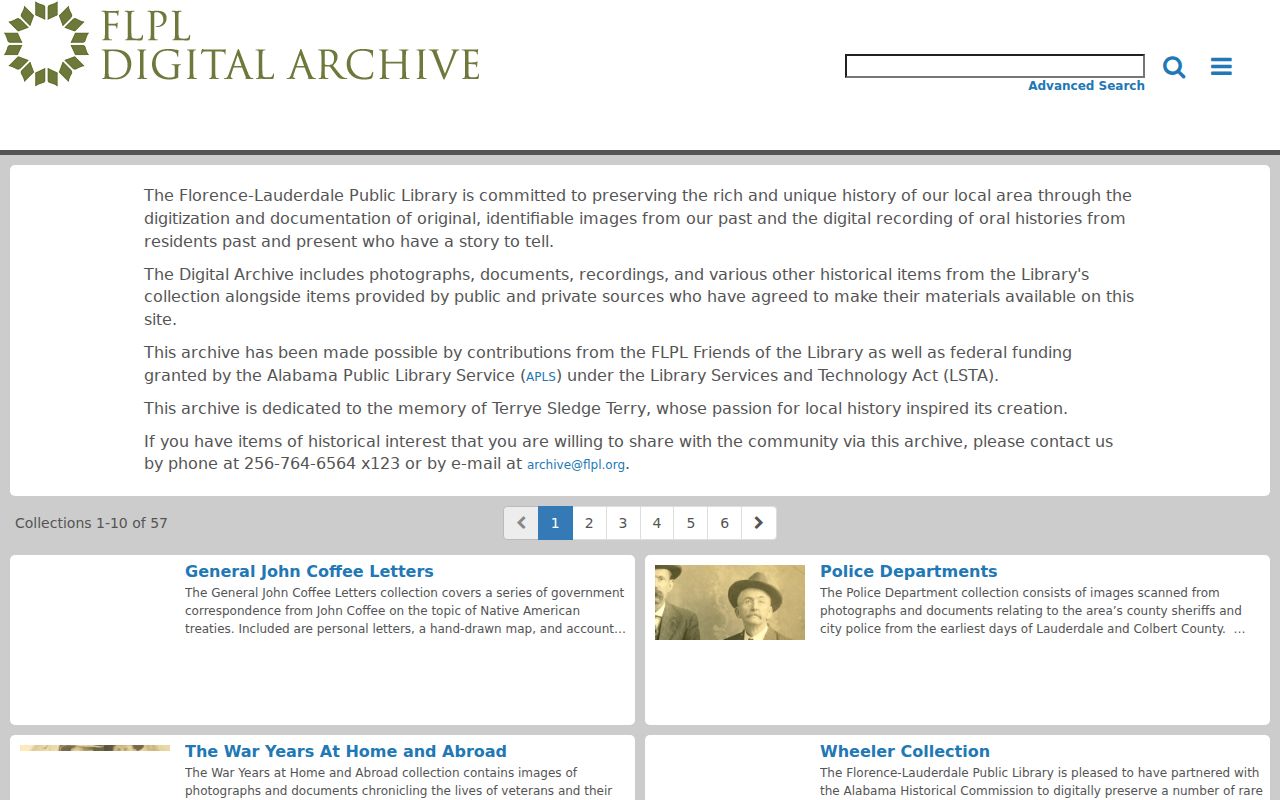
This archive view points beyond the printed line to Florence source material with its own description and date. Keep the directory citation and the digital-item citation separate.
Read a Florence Directory Entry
An entry must be read as a small bundle of fields, not just a name. The local 1913 and 1920 business pages visibly include a personal, business, or church name, a category, an address, and sometimes the proprietor or official. Residential directories commonly add initials, a spouse, occupation, and telephone. Florence research did not recover a complete local residential abbreviation key or verify a local owner/renter symbol, so no mark should be expanded from memory. Photograph the key from that exact volume before decoding shorthand.
| Name line | Surname and given name or initials; business and church names may lead their own entries. |
|---|---|
| Relationship clue | A spouse or other household notation may distinguish two people with the same name. |
| Occupation | A trade, role, or employer may help track a person through later years. |
| Address | A house number and street, or an older relative location between streets. |
| Editorial mark | Meaning comes from the volume's key and historical context, not a universal rule. |
- Criss-cross directory
- A later directory section arranged by street and house number instead of surname.
- Householder index
- An address-order list used to move from a place to a named subscriber or listed household.
- Abbreviation key
- The publisher's legend for shortened terms and symbols in that specific edition.
Florence Directory Run by Year
The strongest numerical feature is the FLPL shelf from 1963 through 2010. That long run lets a researcher follow a surname, spouse, street address, or telephone listing in small steps rather than leap from one federal census decade to the next. Earlier Florence city directories are far more intermittent. The shift matters: a sudden address change between adjacent later editions is stronger timing evidence than a change across a ten-year gap.
Even annual publication is not a live resident roll. Canvass dates may precede the cover year, people could decline a listing, and an address might be omitted. Treat each book as a dated snapshot. Then seek a deed, obituary, census schedule, or phone book before deciding why the line changed.
Florence Directories Meet Yearbooks
Telephone books and school annuals can recover people who do not appear cleanly in an alphabetic city directory. FLPL holds Bell South books for 1929-30, 1948, and 1951-2010. Its yearbook groups include Coffee Pot from 1921-2004 with gaps, UNA's Diorama from 1948-97 and 1999-2010, and Bradshaw from 1969-2003 with gaps. UNA Collier Library's Archives and Special Collections also keeps university and regional papers, photographs, and ephemera.
A phone listing may establish a subscriber and street, while a yearbook can provide a class or activity clue. Neither proves that every family member shared that address. When the goal is a former classmate, begin with the annual, then use the nearest directory year to connect the name to Florence. The UNA archive is a research fallback, not a public alumni name lookup.
Trace Florence Families by Directory
Family history works best when every spelling, initial, spouse, occupation, and address is copied exactly. Start with a year supported by another fact. Move one volume at a time where the shelf allows it. A reverse or street section, if present, checks the address from the other direction. The modern address-keyed method belongs in the Florence street directory, while the historical shelf remains the key tool here.
- Find the person in the alphabetic section and save the full entry plus title page.
- Check the same name in the next earlier and later available volumes.
- Record each spouse, occupation, phone, and address change without merging namesakes.
- Pair the 1900 or 1920 directory era with federal census schedules, and use the publicly released 1950 census for mid-century households.
- Use an obituary index, cemetery record, deed, or probate file to explain the end of a run.
Disappearance has several possible causes. A person may have moved, died, changed a surname, lacked a telephone, or been missed by the canvass. Publication gaps add another cause. Two independent records should support the conclusion.
Florence Directory Research at FLPL
FLPL Local History and Genealogy is on the second floor at 350 N. Wood Avenue. The room is open Monday through Thursday from 10 a.m. to 7 p.m., Friday and Saturday from 10 a.m. to 5 p.m., and Sunday from 1 to 5 p.m. Its phone is 256-764-6564, extension 130. Staff can orient a visitor to books, microfilm, obituary indexes, county records, grave resources, and historical newspapers.
Genealogy workstations have two-hour sessions. Local residents use library cards, while visitors may obtain a guest pass with photo identification. This in-person route is important because the complete Florence city directory shelf is not presented as a full online run. Ask about the exact year before traveling, and bring names, spelling variants, and a date range.
Note: Wood Avenue was once Market Street, so an old entry may require both street names during an address search.
Florence Directory Archive Fallbacks
The Alabama Department of Archives and History holds another useful, though less dense, Florence set. Verified years include 1913-14, 1920-21, 1926, 1959, 1960, 1962-78 in listed groupings, and selected later editions through 2001. Its copies can confirm a citation or serve when FLPL access is not practical. The ADAH county-records catalog also points researchers toward older Lauderdale County microfilm, though many originals remain with the local office.
For news-based confirmation, FLPL indexes Florence Times obituaries from 1890-1947, selected Florence Herald and TimesDaily periods, and death announcements from 1988-98. The scarce African American newspaper The Watcher survives from August 1888 through May 1889 at UNA Collier. Together, the library, university archive, state archive, and online image collections form the real fallback chain when a city directory year is absent.